For years, smartphone innovation has been dominated by faster processors, better cameras, and sleeker designs. But one critical component has remained frustratingly stagnant: the battery. Now, a new technology—silicon-carbon batteries—is promising a major leap forward. And interestingly, it’s not Apple, Samsung, or Google leading this shift. Instead, Chinese manufacturers like Oppo, OnePlus, Vivo, and Xiaomi are pushing ahead aggressively.
So what’s really going on? Why are some companies embracing silicon-carbon batteries while others are holding back?
Let’s break it down properly.
The Limits of Traditional Lithium-Ion Batteries
To understand the shift, you first need to understand the problem.
Most smartphones today still rely on lithium-ion batteries with graphite anodes. This technology has been refined for decades, but it’s hitting a hard ceiling. Graphite simply cannot store more lithium ions beyond a certain point.
That means:
- Battery capacity improvements are minimal (often just 3–5% per year)
- Bigger batteries require physically larger phones
- There’s little room left for meaningful innovation
In simple terms: we’ve squeezed graphite as much as possible.
Enter Silicon-Carbon Batteries
This is where silicon-carbon technology comes in.
Instead of using pure graphite in the anode, manufacturers mix silicon with carbon. The reason is simple: silicon can store far more lithium ions than graphite.
- Graphite capacity: ~372 mAh/g
- Silicon capacity: up to ~10x higher theoretically
That’s a massive jump.
In practical terms, this means:
- Higher battery capacity in the same space
- Thinner phones with larger batteries
- Faster charging capabilities
Silicon-carbon batteries achieve this by combining:
- Silicon → for higher energy storage
- Carbon → for structural stability
This hybrid design allows manufacturers to increase energy density without completely destroying battery durability.
Chinese Brands Are Moving Fast
Chinese smartphone companies aren’t waiting around.
Brands like:
- Oppo
- OnePlus
- Vivo
- Xiaomi
have already started deploying silicon-carbon batteries in commercial devices.
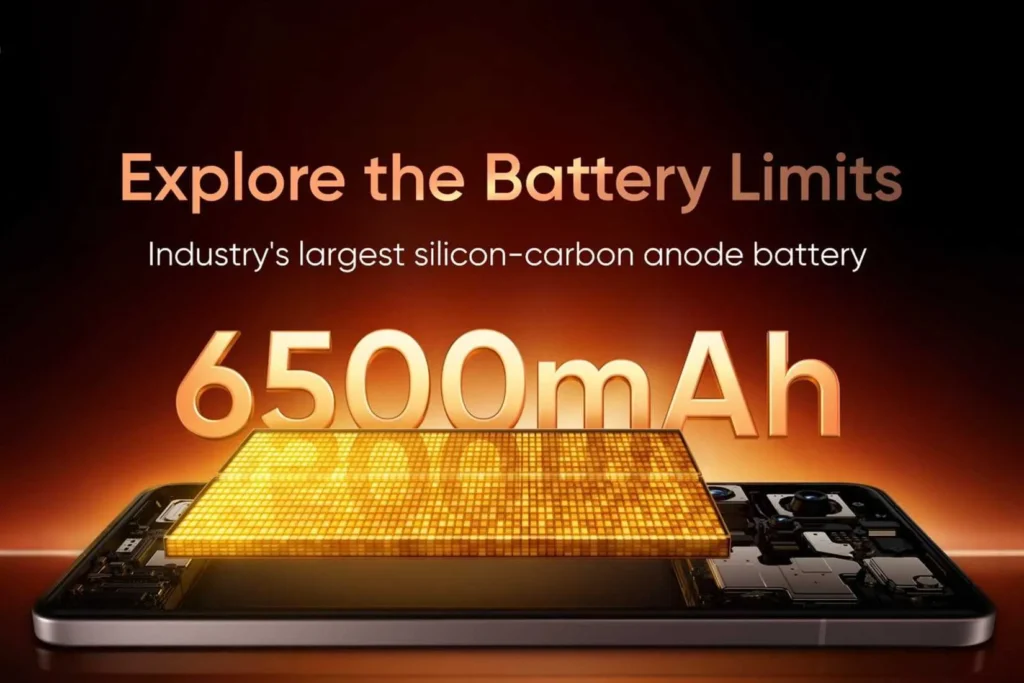
For example, newer flagship phones are pushing 6000mAh to 7000mAh capacities without making devices bulky.
This is a big deal because traditionally:
- Bigger batteries = thicker phones
- Slim phones = compromised battery life
Silicon-carbon breaks that trade-off.
Oppo has even used this tech in ultra-thin foldables, showing how it enables both compact design and long battery life simultaneously.
In short, Chinese companies are treating silicon-carbon as a competitive advantage.
But There’s a Catch: Silicon Is Unstable
Now here’s the part most people ignore.
Silicon is powerful—but also problematic.
When lithium ions enter silicon during charging, the material expands significantly. When discharged, it contracts again.
This repeated expansion and contraction causes:
- Mechanical stress
- Cracking inside the battery
- Faster degradation over time
In extreme cases, silicon can expand by 300–400%.
That’s not a small issue—that’s a structural nightmare.
Why Silicon-Carbon (and Not Pure Silicon)?
To deal with this, manufacturers don’t use pure silicon.
Instead, they use a small percentage of silicon (typically 5–15%) inside a carbon matrix.
This reduces:
- Expansion
- Structural damage
- Safety risks
But it also limits how much benefit you get.
So the entire industry is balancing one question:
How much silicon can you add before the battery becomes unreliable?
The Risk Factor: Why Big Brands Are Hesitating
This is where Apple, Samsung, and Google come in.
Unlike Chinese brands, these companies operate differently.
They:
- Sell at massive global scale
- Prioritize long-term reliability
- Face stricter regulatory scrutiny
- Have reputations built on consistency
And that changes everything.
1. Safety Concerns
Battery failure is not a small issue.
Samsung learned this the hard way with the Galaxy Note 7 crisis, where battery failures led to global recalls.
Now, Samsung explicitly states that silicon-carbon batteries don’t yet meet their safety and performance standards.
That alone explains a lot.
2. Long-Term Durability Is Still Unproven
Silicon-carbon batteries look great on paper.
But:
- How do they perform after 2–3 years?
- Do they degrade faster?
- Do they swell over time?
These questions don’t yet have solid, large-scale answers.
Even reports suggest:
- Potentially shorter lifespan
- Faster degradation under stress
For companies like Apple and Google, that’s unacceptable.
3. Scale Changes the Risk
Here’s something people underestimate:
- OnePlus ships millions of phones
- Samsung ships hundreds of millions
If something goes wrong:
- A smaller brand deals with limited fallout
- A giant brand faces global crisis
So even a 1% failure rate becomes catastrophic at scale.
That’s why bigger companies are far more conservative.
4. The U.S. Market Factor
Apple, Samsung, and Google dominate markets like the United States.
And in these markets:
- Consumers value reliability over experimentation
- Regulations are stricter
- Product liability risks are higher
Because they already dominate these markets, they don’t need to take aggressive risks.
Meanwhile, Chinese brands:
- Compete aggressively on specs
- Use innovation as differentiation
- Move faster to gain market share
Different incentives → different strategies.
5. Supply Chain and Cost Issues
Silicon-carbon batteries are not just a technical challenge—they’re a manufacturing challenge.
Problems include:
- Limited supply chains
- Higher production costs
- Complex manufacturing processes
For companies producing at massive scale, even a small cost increase matters.
So Who’s Right?
This is where things get interesting.
Chinese brands are not reckless—they’re simply:
- Moving faster
- Accepting calculated risks
- Iterating in real-world conditions
Meanwhile, Apple, Samsung, and Google are:
- Playing the long game
- Waiting for maturity
- Avoiding potential disasters
Both strategies make sense.
The Reality: Silicon-Carbon Is Still Transitional
Despite the hype, silicon-carbon is not the final answer.
It’s a bridge technology.
Why?
- It improves capacity by ~10–30%, not 10x in real-world use
- It still suffers from degradation issues
- It requires careful engineering to remain stable
The real long-term solution is likely:
- Solid-state batteries
- Or more advanced hybrid chemistries
What Happens Next?
Here’s the most realistic scenario:
- Chinese brands continue pushing silicon-carbon
- Technology improves gradually
- Silicon percentages increase safely
- Reliability data accumulates
- Big brands adopt it later—once proven
In fact, even Samsung has confirmed it is actively developing the technology, just not ready to deploy it yet.
So this isn’t rejection—it’s delay.
Final Verdict
Apple, Samsung, and Google are not “behind.”
They’re cautious.
Silicon-carbon batteries offer:
- Higher capacity
- Better efficiency
- Thinner designs
But they also bring:
- Structural instability
- Long-term durability concerns
- Manufacturing complexity
Chinese companies are willing to experiment now.
Big global brands are waiting for certainty.
And honestly? Both approaches are rational.
The Bottom Line
If you want cutting-edge battery innovation today, Chinese smartphones are ahead.
If you want proven reliability at massive scale, Apple, Samsung, and Google are still playing it safe.
The gap will close—but not until silicon-carbon batteries prove they can survive years of real-world use without failure.
Until then, this isn’t about who’s better.
It’s about who’s willing to take the risk first.

No responses yet